Every Day I Write (In This Case Read) The Book
Given my broadcasting background, I had dreams of narrating my first book, WAR BONDS. I knew exactly how I wanted my characters to sound, from the Florida-born pilot with the cultivated Southern accent to the earnest British boys dazzled by the exploits of their new American friends. But managing the WAR BONDS book launch —from finalizing the manuscript and cover; prepping my website and socials; deciding the venue and menu for the launch party—demanded all the event-planning skills I could summon. Next book, I thought. I’ll narrate that one. How hard can it be?
Let me tell you, friends: very.
My husband is a musician and we have a recording studio in our home. (You can hear the music he creates on his SoundCloud channel. 60,000+ listens!) He knows LOTS about recording complex pieces on multiple tracks—how to move the bank of faders and buttons and knobs on his recording deck to get the sound he wants. He knows how to edit and fade and drop in a fix in the middle of a track. He’s got the expensive microphone, mic stands, music stands—all the THINGS. So he was game to step in as audiobook producer. And since I began my career in radio and worked in TV, we were pretty sure I knew how to narrate. After all, I had been reading aloud since the Bunny Reading Group in first grade. Surely, we had all the tools to give THE FLORENTINE ENTANGLEMENT the nuanced narration I wanted. Well. Yes and no.
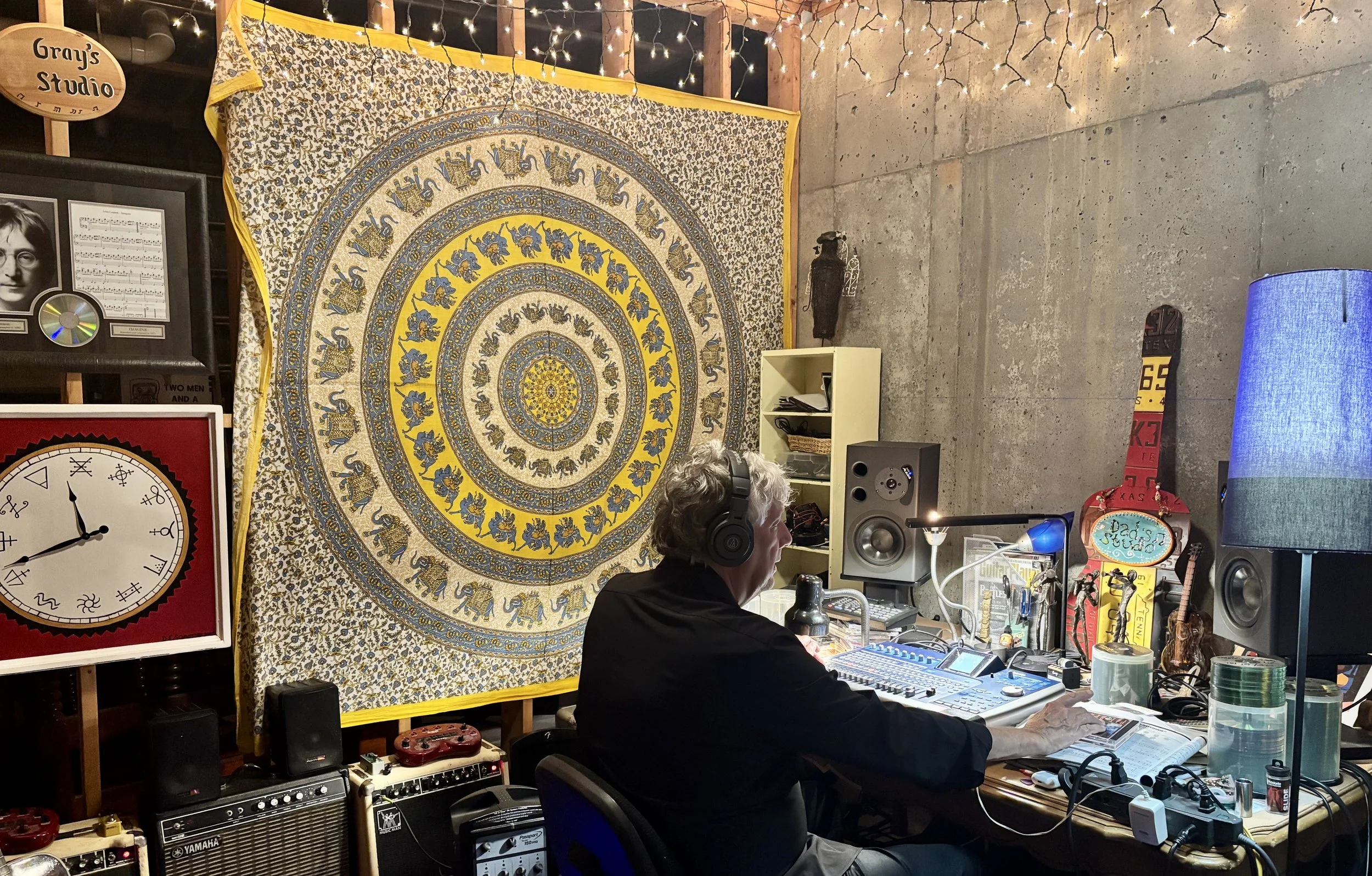
My publisher selects narrators via ACX—Audiobook Creation Exchange—which is Audible’s platform owned by Amazon. So my first step was to create an account and uploading a sample narration into the ACX system. And miracles of miracles, my publisher selected me from a roster of sonorous voices to narrate THE FLORENTINE ENTANGLEMENT! In truth, I’d let him know months earlier I wanted to do this so the fix was in. Next, my producer/husband signed in to ACX to take stock of the technical requirements for recording an audiobook. He quickly realized that, despite all the cool hardware in our home studio, we would need a completely different set up. Rather than use our audio equipment, we would need to plug our fancy mic into an interface to record on a laptop on the digital ACX proprietary software, Audacity.
YouTube helped us understand exactly how Audacity works.
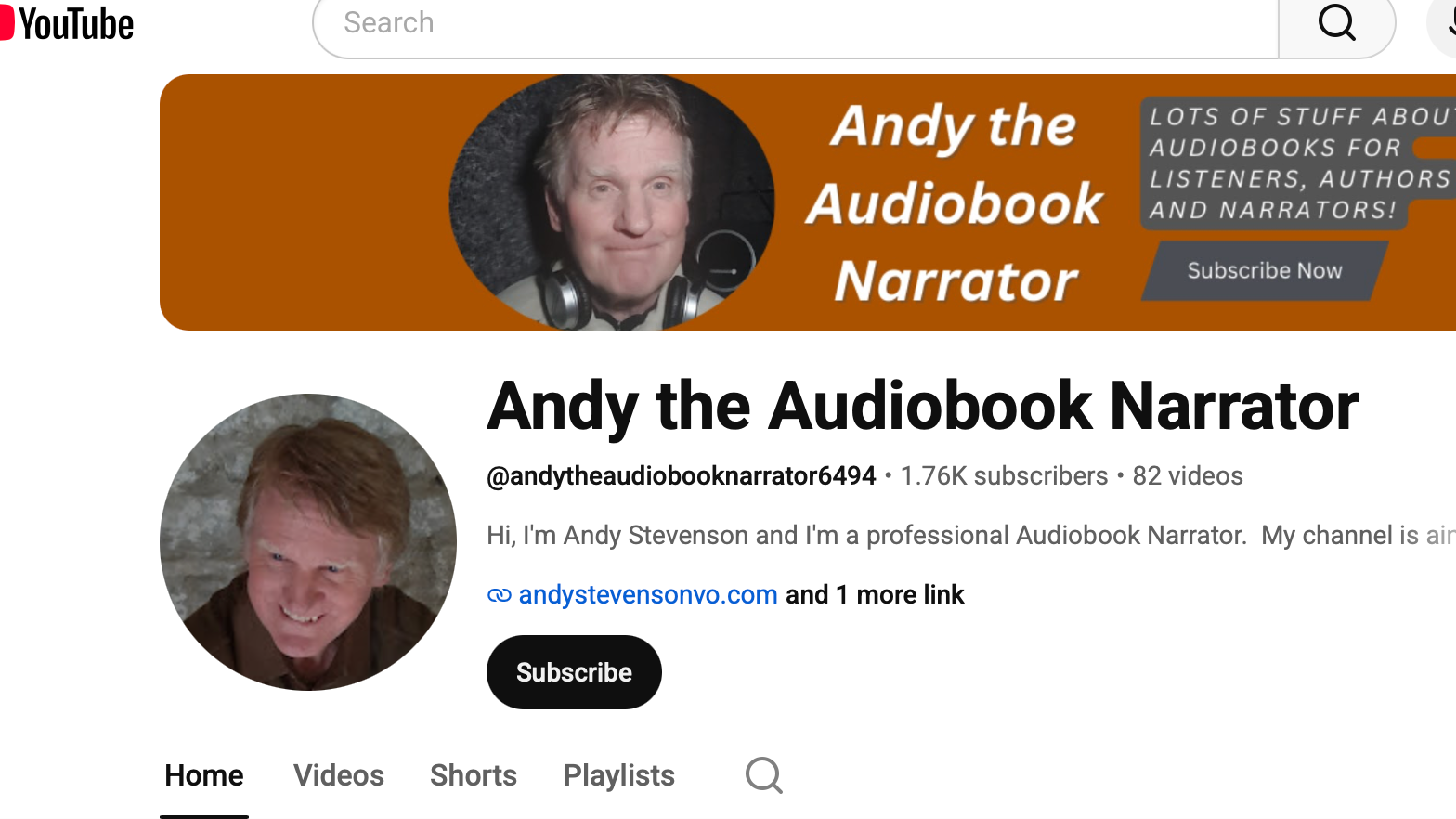
Our first tutor was Andy the Audiobook Narrator, who records books with great success from his flat outside London. In a seven-part series, Andy outlined everything from creating a quiet place to record (closets work well) to meeting Audacity’s very specific standards: how to eliminate distortions by ensuring peak amplitude wasn’t clipped; how to measure RMS—the Root Mean Square—to match volumes between tracks; how to keep the noise floor at an acceptable level (below -60 dB RMS); how to use the Contrast Analyzer to measure the precise RMS difference between foreground speech and background noise. So, Andy, I thought. I’m picking up that there’s a little more to it than just turning on the recorder and reading. I was amused at how he pointed out the importance of all these dense metrics then reassured his viewers they didn’t need to understand any of it. They just had make sure to insert a specific numerical value in a certain field in a dropdown menu to solve it. He also highlighted particular features of Audacity—like the phone filter—which we used for phone call dialogue in my book. Andy was a great resource.
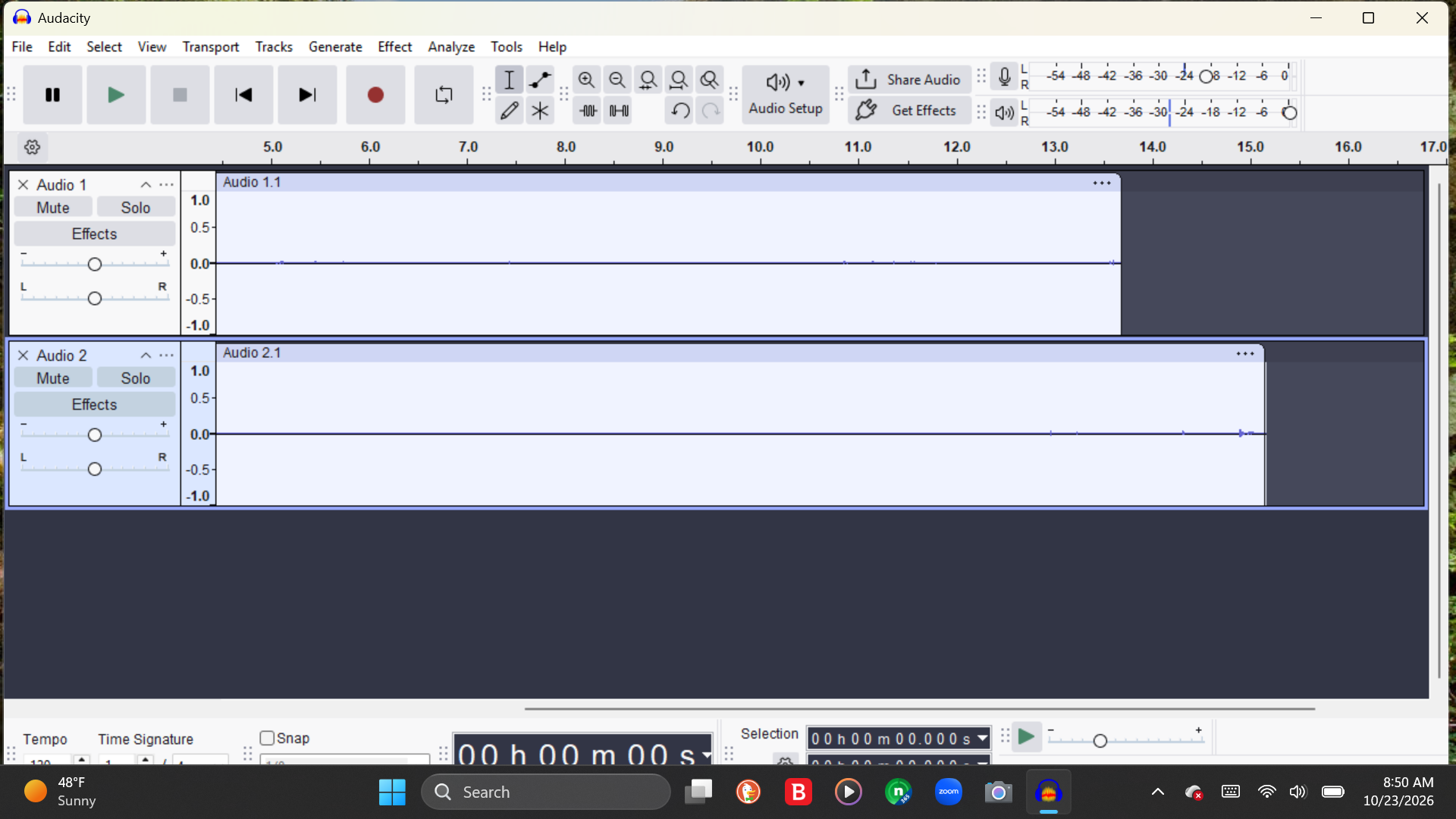
Audacity opening screen for a new project
I also watched a video by an Audible honcho who made a bold assertion: narrators should read a book before recording it. Wild, right? But there are actually people out there who can walk into the booth and cold-read entire novels. Does this produce the most satisfying audiobook for listeners? What about all the voice-actor stuff—the hesitations, inflection, accents or speech differentiation among characters? I have a hunch that doesn’t happen on a first read-through. The honcho also reminded narrators they can’t change a single word of a book. Not even if they wrote it. Not even “a” for “the.” It has to be a 100% match to the printed work. So I had one thing going for me; I had read my book (many times).
Ashley Hasty of Chicago Literary Salon fame, was also a reservoir of information, She has featured both my books on her website but more importantly, has a library of interviews about audiobook narration tips and tricks—specifics on what listeners love about particular narrators. Nasal is a killer. The worst. Breaths and mouth noises will set off the mob. A tendency to swallow the last syllable? Audiobook listeners will yank out their earbuds and boycott.
We decided our home studio had too much echo, so we’d record in a walk-in closet. My producer/husband installed acoustic tiles and hung blankets to deaden the sound. I prepared my manuscript, reading through it (again), starring tricky passages, and color-coding characters—a signal to alter my approach to a piece of dialogue. I read from my Mac to avoid paper shuffling sounds on the recording.
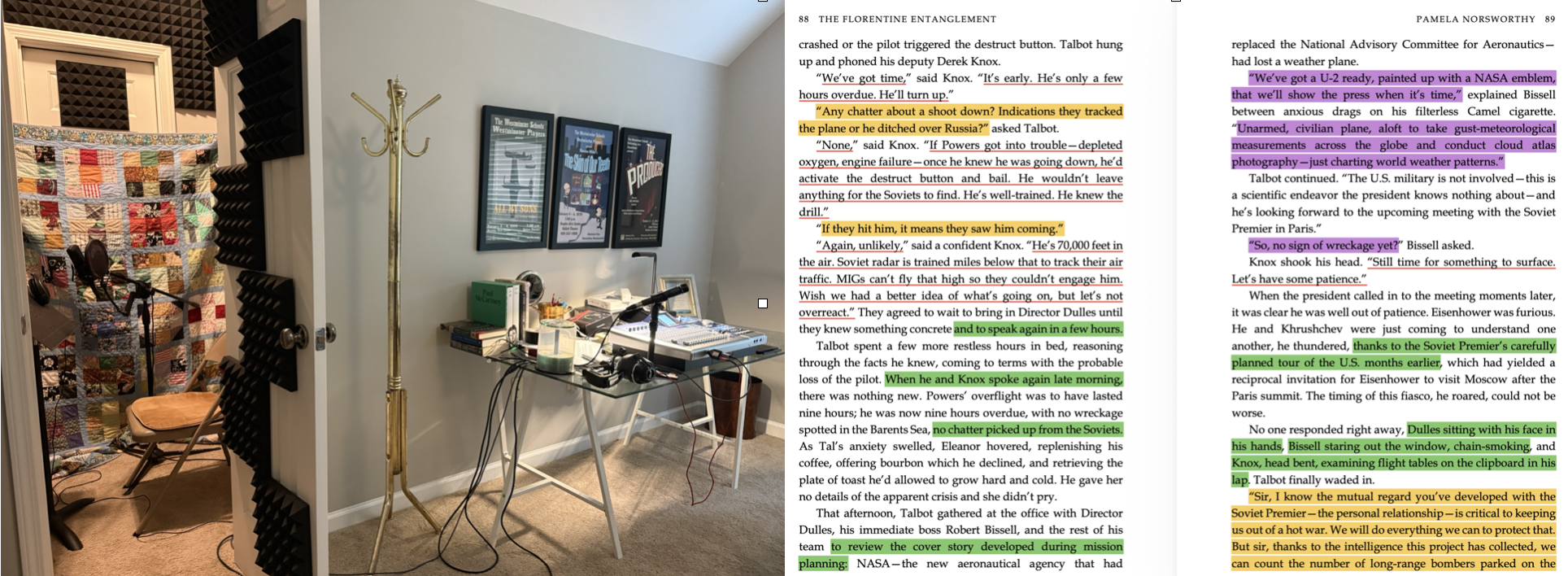
FLORENTINE has lots of international characters so I wanted to give each a hint of an accent. I went back to YouTube where I found videos with titles like “Russian for English speaking actors” and “How to sound a little Italian.” There’s also a French character in FLORENTINE and as we got into the actual recording, my biggest challenge was narrating conversations between these characters—remembering how the French soften their “t’s” while the Italians do not; opening vowels and rolling initial R’s to sound Rahsshen. There were times my tongue got confused trying to sort this out. After one session, when my husband and I listened back to a passage involving Russian and a smattering of Italian, he turned to me, perplexed, and said, “You sound like Speedy Gonzales.” We dissolved into giggles—one of many times laughter proved the balm to this demanding, fatiguing enterprise. Given the fact there were no Spanish-speakers in the book, I headed back into the closet (once I stopped laughing) to rid the track of any whiff of Speedy Gonzales.
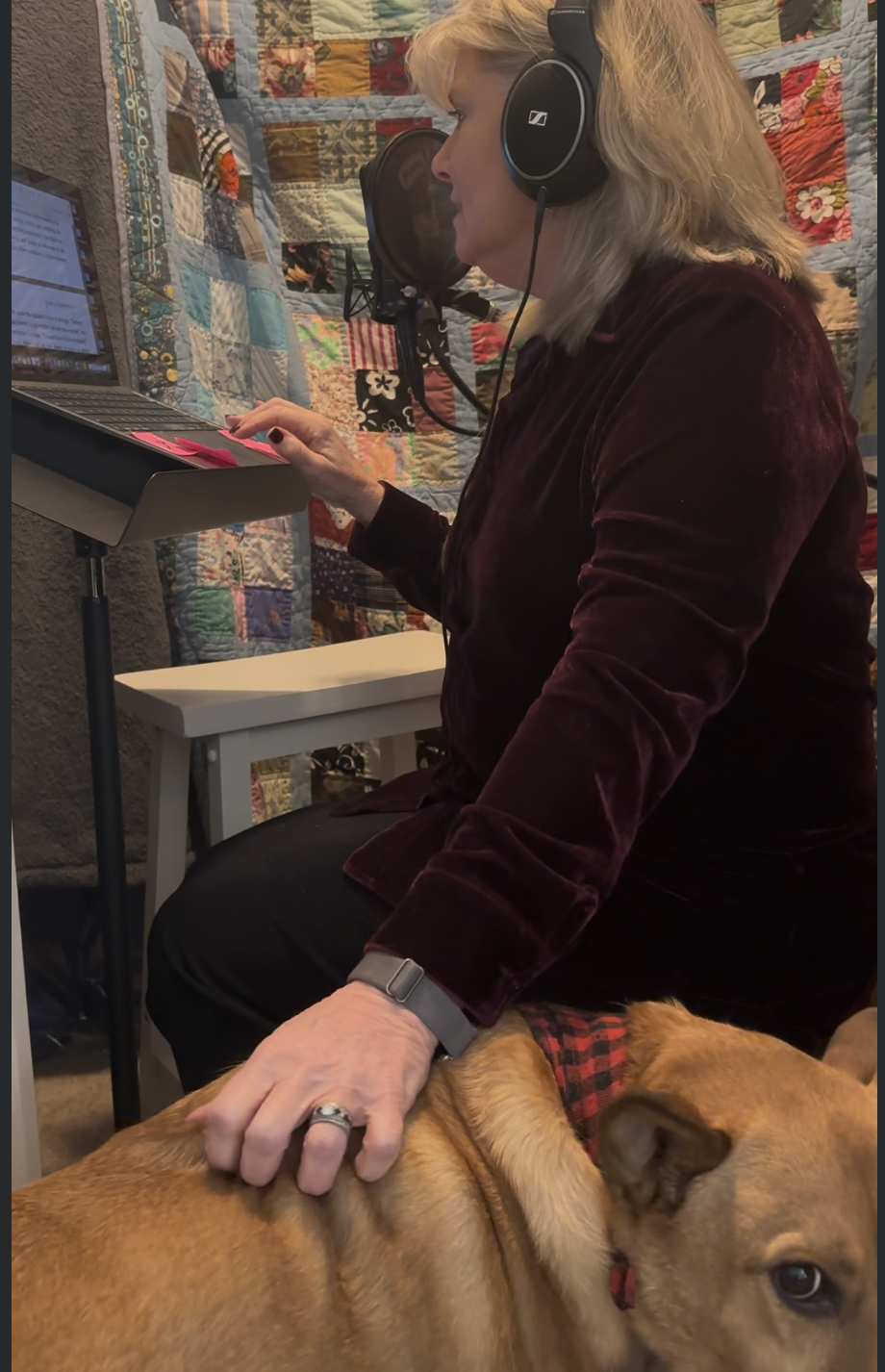
Our goal was to complete a chapter a day and the actual recording time each day was minimal—thirty to forty minutes. But finalizing a chapter-track often took all day because it’s a multi-step process and because of distortions that mysteriously arise in digital recordings. Say “actually” with a little too much oomph and the “act” sound pops off like machine gun. You need to have good diction without emphasizing hard consonants too-too much. And there were times my brain reworded things on the fly, or I’d written a phrase that turned out to be an impossible tongue-twister. So these required re-dos. But the arduous work was clipping out breaths, lip smacks, pauses, (and dog whimpers) on the track. Once this was complete, we’d listen through again and find yet more funny little sounds to address. When THAT was resolved, my husband would finalize the recording by sending it through the ACX Audio lab to flag any issues. Usually, we had to adjust something or other and re-submit. But once we got the sign-off from the Lab, we knew the track was good to go. So we’d thank the guy in the photo, believing him personally responsible for giving us the a-ok. Then my producer/husband would convert the track to the proper file type, and park it in a file to be uploaded when every chapter was complete.
Forty-two chapters. Epilogue. Author’s Note. Acknowledgements. You do the math on just how many days it took. But satisfying? Gratifying? Yes. You can hear the first chapter of FLORENTINE below. We learned a ton as we worked, lessons I can apply to future projects; I have it in my head to narrate the next book. But like having a baby or running a marathon, it will take a little time to forget how hard it is. So let’s not tell my producer/husband about this just yet.